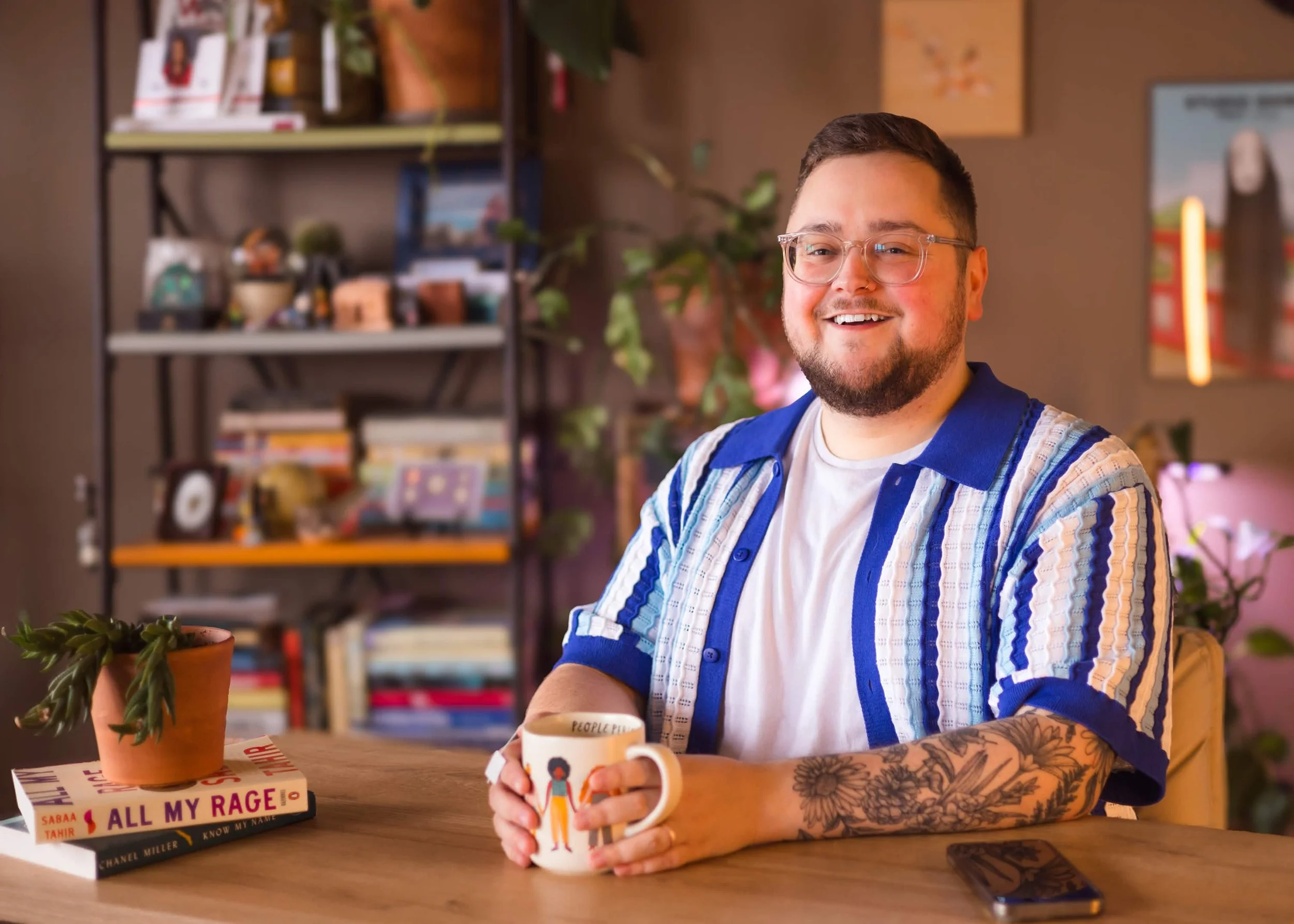
About Kody Garis, LPC
I believe that healing happens best when you don’t have to leave parts of yourself at the door.
Outside of my work as a therapist, I’m a person who loves cozy routines, good stories, creative or nerdy projects, and spending time with the people and animals I love. I live in Norman with my husband and our two dogs, who keep life playful and chaotic.
While therapy is always centered on you, I also believe it can be helpful to know there’s a real person sitting across from you — someone warm, curious, grounded, and human.
My Values and Identity…
I think you deserve to know something about the person you’re trusting with some of the most vulnerable parts of your life—including some of the identities and values that shape how I show up in the therapy room.
Some of the identities I hold are: white, queer, cis-man. I know that the identities and experiences I carry affect what I notice, what I understand, the privileges I hold, and the things I may sometimes miss.
There is an inherent power dynamic in therapy, and I take that very seriously. I want our relationship to feel collaborative, transparent, and open to feedback. You are the expert on your own life. My role is to bring curiosity, clinical knowledge, honesty, and care while making room for your wisdom about yourself.
My work is queer- and trans-affirming, anti-racist, fat-positive, and grounded in the belief that our individual healing is deeply connected to our relationships, bodies, communities, identities, and the systems we live within. I believe this work requires ongoing learning, unlearning, and a willingness to notice my own blind spots. I regularly seek consultation, continuing education, and feedback to help me keep doing that work.
And if something doesn’t sit right with you in therapy, I hope we can talk about it. I see feedback as an important part of building trust, and I want you to know that there is room for you to disagree with me, correct me, or tell me when I’ve missed something.
At the core of my approach to therapy is a belief that change begins with curiosity, compassion, and honesty.
Therapy with me…
I don’t believe therapy should feel like you’re performing emotional insight and doing all of the heavy lifting while someone quietly nods at you. In our work, I want you to feel heard, understood, and cared for—and I also want you to leave with something you can actually use. Sometimes that’s a skill, sometimes it’s a new way of understanding yourself, and sometimes it’s language for something you’ve felt for a long time but couldn’t quite put words to.
I tend to be active and honest in session. I’ll ask questions, offer reflections, explain what I’m noticing, and help you make sense of the patterns showing up in your life. I also value psychoeducation, so part of our work may include learning about why your brain, body, relationships, and protective habits respond the way they do. My goal is for things to feel less mysterious, less shameful, and more workable overall.
At the same time, therapy with me is not just about learning coping skills or “fixing” yourself. It’s also a space to be vulnerable, curious, emotional, and human. We’ll make room for your stories, your humor, your hard truths, as well as the parts of you that may not feel welcome everywhere else.
I want therapy to feel warm, real, and useful—a place where you can understand yourself more deeply and begin practicing something different.
Where I do my best work:
-
You deserve therapy where your identity is affirmed, respected, and never treated like the problem. I work with LGBTQIA2S+ clients navigating identity concerns, relationships, family dynamics, religious or cultural harm, trauma, and the general exhaustion of having to explain yourself everywhere else. We may be a good fit if you’re looking for a space where all of you is welcome, without needing to shrink, translate, or defend who you are.
-
Complex trauma can show up as overthinking what you said, bracing for people to be upset with you, feeling uncomfortable when things are calm, or having reactions that feel bigger than the situation. I work with clients who learned to survive by paying close attention to other people, pushing down their own needs, or becoming really good at getting through things alone. We may be a good fit if you’re tired of feeling hijacked by your reactions, second-guessing yourself in relationships, or feeling like you have to stay prepared for things to fall apart.
-
People-pleasing can show up as saying yes before you’ve had time to think, feeling guilty when someone is disappointed, overexplaining your boundaries, or keeping the peace even when it costs you. I work with clients who are used to being the flexible one, the responsible one, the fixer, or the person who can “handle it,” even when they’re quietly overwhelmed, resentful, or disconnected from themselves. We may be a good fit if you’re tired of abandoning yourself to make relationships feel easier and want to practice having needs, limits, and preferences without feeling like you’re doing something wrong.
-
I work with individuals practicing or exploring consensual non-monogamy, polyamory, open relationships, and other nontraditional relationship structures. Whether you’re navigating communication, jealousy, agreements, attachment, identity, or relationship transitions, therapy can be a space to slow down and sort through what’s actually happening underneath the surface. We may be a good fit if you want support that is affirming, curious, and free from assumptions about what your relationships “should” look like.
(My “specialties”)
Therapeutic approaches:
-
Somatic therapy helps bring the body into the healing process, because stress, trauma, and emotion don’t just live in your thoughts. In session, we may pay attention to body cues, nervous system responses, grounding skills, breath, tension, or the ways your body has learned to protect you. This approach can be helpful if you often feel stuck in your head, overwhelmed by your body’s reactions, or like you understand things logically but still feel them physically.
Learn more about Somatic Therapy here. -
Internal Family Systems (IFS), is a way of understanding the different “parts” of you — the protective parts, the anxious parts, the people-pleasing parts, the angry parts, the tender parts, and everything in between. Instead of trying to shame or shut those parts down, we get curious about what they’re protecting and what they might need. This approach can be especially helpful if you feel pulled in different directions, stuck in old patterns, or disconnected from the version of yourself you’re trying to become.
Learn more about IFS here. -
Attachment-based therapy looks at how your relationships, especially early or meaningful ones, have shaped the way you connect, protect yourself, and respond to closeness or conflict. Together, we’ll explore patterns around trust, boundaries, intimacy, fear of abandonment, people-pleasing, or shutting down. This approach can be a good fit if you find yourself repeating relationship patterns and wondering, “Why do I keep doing this?” or “What’s wrong with me?”
Learn more about ABT here. -
Narrative Therapy is a way of exploring the stories you’ve learned to tell about yourself, your relationships, and what your experiences mean. Sometimes those stories come from family, culture, trauma, shame, religion, relationships, or years of being treated a certain way. In therapy, we look at which stories still fit, which ones were handed to you, and which ones are making it harder to see yourself clearly. This approach can be especially helpful if you feel stuck in an old role, defined by a painful experience, or disconnected from the person you know you want to be.
Learn more about Narrative Therapy here.
(Types of therapy I bring to session)
Background & qualifications:
Education:
I earned both of my degrees—a Bachelor’s degree in Language Arts Education with an emphasis on postcolonial literature and a Master’s in Clinical Mental Health Counseling—from The University of Oklahoma.
Licensure:
I am a Licensed Professional Counselor (LPC) in Oklahoma, having completed the education, clinical training, supervision, and examination requirements for independent practice.
My license number is: LPC-12431